Popular Posts

Wednesday, February 18, 2015

Winter Trees

William Carlos Williams, 1883 - 1963

All the complicated details 
of the attiring and
the disattiring are completed!
A liquid moon
moves gently among
the long branches.
Thus having prepared their buds
against a sure winter
the wise trees
stand sleeping in the cold.
…Doc Williams, Rutherford

Welcome to Lent, to another snowbound day, to the first glimpses of sunshine in a week.  The trees are not dead; they are at rest, having completed another annual sequence of dressing and undressing.  During this season, we are also waiting, preparing ourselves for the spring that lies ahead.  Instead of giving something up, what are we to take on?  What are we going to lift up instead?
Today's Writing Prompt:
Williams' line "A liquid moon moves quietly among the long branches" is like a haiku within the walnut shell of this short poem, a beautiful image of white, cold light.  Take a few minutes to create a clear winter image.  Later on, put it in the middle of something else.
Keep reading and writing,
Maureen

Tuesday, February 17, 2015

Do you know what work is?


We stand in the rain in a long line
waiting at Ford Highland Park. For work.
You know what work is--if you're
old enough to read this you know what
work is, although you may not do it.
Forget you. This is about waiting,
shifting from one foot to another.
Feeling the light rain falling like mist
into your hair, blurring your vision
until you think you see your own brother
ahead of you, maybe ten places.
You rub your glasses with your fingers,
and of course it's someone else's brother,
narrower across the shoulders than
yours but with the same sad slouch, the grin
that does not hide the stubbornness,
the sad refusal to give in to
rain, to the hours wasted waiting,
to the knowledge that somewhere ahead 
a man is waiting who will say, "No,
we're not hiring today," for any
reason he wants.
You love your brother,
now suddenly you can hardly stand
the love flooding you for your brother,
who's not beside you or behind or
ahead because he's home trying to
sleep off a miserable night shift
at Cadillac so he can get up
before noon to study his German.
Works eight hours a night so he can sing
Wagner, the opera you hate most,
the worst music ever invented.
How long has it been since you told him
you loved him, held his wide shoulders,
opened your eyes wide and said those words,
and maybe kissed his cheek? You've never
done something so simple, so obvious,
not because you're too young or too dumb,
not because you're jealous or even mean
or incapable of crying in
the presence of another man, no,
just because you don't know what work is. 


…"What Work Is," Philip Levine, Detroit

Directing you to this article from The Economist regarding the selection of Philip Levine as our Poet Laureate.  In this piece, Levine is connected to Jersey Guys Walt Whitman and F. Scott Fitzgerald, two looming figures in the manufacture of the American Dream (always different things to different people.)
Levine passed this week, after a life of observing the classism in America and the mindless drudgery of some people's work.  Was he our Emile Zola?  Were our cleaning ladies France's miners?  He does not sing the song of altruism and the value of work; he acknowledges the process of grinding down the grain.

Today's Writing Prompt:

Consider your work today. Write carefully about doing a single mundane task involved in your daily process.  Capture the details, feel the textures of what's around you.

Keep Reading and Writing,

Maureen

Sunday, February 15, 2015


At thirteen, I screamed,
“You’re disgusting,”
drinking your coffee from a saucer.
Your startled eyes darkened with shame.

You, one dead leg dragging,
counting your night-shift hours,
you, smiling past yellowed,gaping teeth,
you, mixing the eggnog for me yourself
in a fat dime store cup,

how I betrayed you,
over and over, ashamed of your broken tongue,
how I laughed, savage and innocent,
at your mutilations.

Today, my son shouts,
“Don’t tell anyone you’re my mother,”
hunching down in the car
so the other boys won’t see us together.

Daddy, are you laughing?
Oh, how things turn full circle,
my own words coming back
to slap my face.

I was sixteen when you called one night from your work.
I called you “dear,”
loving you in that moment
past all the barriers of the heart.
You called again every night for a week.
I never said it again.
I wish I could say it now.

Dear, my Dear,
with your twisted tongue,
I did not understand you
dragging your burden of love.

…"Betrayals" by Maria Maziotti Gillan, Paterson

Recently, I was told that I have a "blue collar mentality."  What a wonderful thing to have, especially as the great writing of New Jersey often issues from that stream.  I have been pondering, though, what, exactly, the expression means.  Sure, the term "blue collar" itself refers to laborers at the turn of the last century who wore blue shirts to work, non-management types who built everything we are standing or sitting on right now.  People who wear  uniforms -cops, nurses, firefighters.  Some had more education than others did, but they still worked with their hands and brains to get things done.  Nobody made them coffee; nobody handed them their schedule at the beginning of the day.  What, then, is the mentality of a person like this?
I am still trying to get it.  I guess it means that I don't think like a rich person, that I have no sense of entitlement or that I am owed anything.  Everything a blue collar person gets, she gets by working.  Maria Maziotti Gillan knew that about her father; she knew it about all the Italian-Americans in her working-class neighborhood in Paterson.  She knows it now and it still informs her newest publication The Girls in the Chartreuse Jackets.  In these pieces, women who have earned their joy get to celebrate it.

Today's Writing Prompt:

Describe your working mother, father, husband, wife, as that person enters the door of your home when returning from a day of work.  What are the motions?  What weight is lifted?  What weights are loaded on?  What happens first before anything is said?  What is your role in this person's arrival?

Keep reading and writing,

Maureen

DON'T MISS THIS!  I'll be there!  Join me!


Tuesday, February 3, 2015


The over-all picture is winter
icy mountains
in the background the return
from the hunt it is toward evening
from the left
sturdy hunters lead in
their pack the inn-sign
hanging from a
broken hinge is a stag a crucifix
between his antlers the cold
inn yard is
deserted but for a huge bonfire
that flares wind-driven tended by
women who cluster
about it to the right beyond
the hill is a pattern of skaters
Brueghel the painter
concerned with it all has chosen
a winter-struck bush for his
foreground to
complete the picture

…The Hunters in the Snow by William Carlos Williams, Rutherford

Doc Williams of Rutherford and Paterson on a winter's day here in New Jersey.  (That downward slope suggests a waterfall, no?) A poem from a painting - art begets art.  A study in depth-of-field.  What were you hunting for today?

Today's Writing Prompt:

Walk around your house and find a picture that you have always liked.  Tell its story in a poem, paragraph, or story.  Not your own story, now, but the story being told by the storyteller.  Right now, I am looking at a framed copy of the Abbey Road album.  Remember how many stories were told about that picture?  How could Paul be dead if he was at the Super Bowl on Sunday?

Keep reading and writing,

Maureen

Monday, February 2, 2015

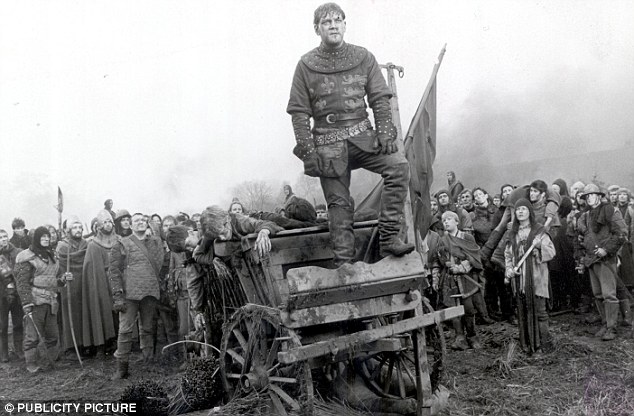
Once more unto the breach...

Once more unto the breach, dear friends, once more;
Or close the wall up with our English dead.
In peace there's nothing so becomes a man
As modest stillness and humility:
But when the blast of war blows in our ears,
Then imitate the action of the tiger;
Stiffen the sinews, summon up the blood,
Disguise fair nature with hard-favour'd rage;
Then lend the eye a terrible aspect;
Let pry through the portage of the head
Like the brass cannon; let the brow o'erwhelm it
As fearfully as doth a galled rock
O'erhang and jutty his confounded base, 
Swill'd with the wild and wasteful ocean.
Now set the teeth and stretch the nostril wide,
Hold hard the breath and bend up every spirit
To his full height. On, on, you noblest English.
Whose blood is fet from fathers of war-proof!
Fathers that, like so many Alexanders,
Have in these parts from morn till even fought
And sheathed their swords for lack of argument:
Dishonour not your mothers; now attest
That those whom you call'd fathers did beget you.
Be copy now to men of grosser blood,
And teach them how to war. And you, good yeoman,
Whose limbs were made in England, show us here
The mettle of your pasture; let us swear
That you are worth your breeding; which I doubt not;
For there is none of you so mean and base,
That hath not noble lustre in your eyes.
I see you stand like greyhounds in the slips,
Straining upon the start. The game's afoot:
Follow your spirit, and upon this charge
Cry 'God for Harry, England, and Saint George!'
                                                         …Henry V, Act III

 
   All-grown-up Prince Hal/King Henry a Jersey guy?  Well, not at all, really.  I chose this passage today because it's about being brave, trying the same thing again and hoping for a victory this time, and heading the call to "follow your spirit."  On this wet and wintry day on what were once the fields of Middlesex, I am seated across from my own Agincourt, a populated box as active as Harfleur and just as daunting. I am trying, as overwhelmed as I am by the great numbers of other writers, the lousy weather, the lack of respect I have been shown lately, and the great many St. Crispian's Days I have passed,  to be a writer.  
     I used to tell my students that the only difference between them and writers was that writers actually wrote something.  Neil Gaiman, it seems, would agree.  Now it is time for me to face that fact myself.
     So, I am a Jersey Writer, too.  I will still report to you about the great work of the great writers from our great state, but I will also keep you informed about the writing process as I go through it myself.  "It's never too late to be what you might have been."  I will also return to my "Today's Writing Prompt" element .  I hope that they help you to think and make you read and write.  First word of advice?  Don't think so much that you forget to write anything!

Today's Writing Prompt:

We are being visited by various mushy forms of snow, sleet, and rain here in the Garden State.  It's nothing like e.e. cummings' "mud-luscious" and "puddle-wonderful" spring day.  Write a short poem in which you play around with the word slush.  (Is it a noun or a verb?  A command?  What does the dictionary say? ) Send me your poem with an image attached.

Keep reading and writing, my band of brothers,

Maureen 

Monday, July 28, 2014

Jersey Boys in All Four Seasons: New Books by BJ Ward and Joe Weil

287 was the long road to the newspaper plant
   my black-handed father would ride beneath
the weight of a night sky.
   A father who works the night shift
knows that weight, how it accumulates from within
   when his mistakes and debt
begin to press on his children and wife.
   And so went his life --

If the stars spelled out something real,
   they might spell the equation
that my father never mastered --
   the news that just ran through his hands
and what slid there left a black residue
   of the world's doings, pressed knowledge
that read like misaligned tea leaves in his hardening palms,
   and in his life line and heart line and other lines
that would normally speak a fortune,
   the night just accumulated itself --
the little sky he would spread over us
   when the world redelivered him in the morning.

…The Star-Ledger in Jackleg Opera by BJ Ward, Asbury, NJ


To be all by yourself in a diner, to stare into the coffee cup and watch the milk disperse, to hear your own spoon scraping the bottom of the cup…Poetry is nowhere near as beautiful as the sound of that spoon.  That's why I keep writing it - ambition.

…Ars Poetica from Nine Diner Poems in The Great Grandmother Light by Joe Weil, Elizabeth, NJ

The two beautiful new collections by BJ Ward and Joe Weil elevate the commonplace, writers running their hands lovingly along the banisters of our experience here in New Jersey.


   Ward's high school poem The Fury, in which "good boys do bad things just not to be good," pretty much spells it out for those of us who were never quite "sprung from cages on Highway 9" or 18 or 17, the compliant kids who became practical adults.  We all get ushered back into the building by some Cerberus after our brief flings.  To Ward, Shakespeare is a waiter in a lonely diner, waiting for his shift to end; a writer with a chthonic grin (I had to look it up for my own sake so I figured, well…); and the cause of a celebratory dance with a teacher.  There are lots of classrooms, roads, diners, highways and factories in Ward's observations, places where loss is contemplated, where knowledge grabs students, and the mundane threatens to grab us all.  Like Billy Collins, he contemplates having sex with Emily Dickinson, while his wife, in the poem, parries that fantasy with some literal drum-banging by Robert Bly.  Lots of allusions there, all of them rolling around with good humor.  (Who knew Wild Nights - Wild Nights! could be such a call to arms?)

   When Joe Weil was a teenager, he ate four new potatoes with butter and pepper and salt off the blade of his Swiss army knife, and read William Carlos Williams in the early morning hours, alone, in his kitchen in Elizabeth.  He fooled around with the tattered linoleum on the floor (Do kids even know what that is today?) and was perfectly content.  Now, Weil is encouraged, comforted, and energized by the "pleasing sound of a vacuum releasing" as he opens a jar of pickles - the sound, the smell, the quiet, the aloneness temporarily warding off "the next ho hum" "at three in the morning, when everything is merciless" "against the scarred linoleum."  Would Williams demand so much of plums?  In this collection, Weil walks through such a series of devastating losses that he becomes unused to "things that stay," retaining his confidence in the commonplace, the small things that make the big ones less scary.  So much depends on them.

So, look, while everybody else at the beach, around the pool, or in your living room is transfixed by their eye-phones (bad pun,) take this chance to read and re-read some of these poems in which you will find yourself, your dad, your wife, a waitress, or some other real people.

Keep reading and writing,

Maureen


Sunday, January 19, 2014

Put Your Makeup On. Fix Your Hair Up Pretty. And Meet Me Tonight in Atlantic City


Now our luck may have died and our love may be cold
But with you forever I'll stay
We're goin out where the sand's turnin to gold
Put on your stockins baby, `cause the night's getting cold
And maybe everything dies, baby, that's a fact
But maybe everything that dies someday comes back

Now, I been lookin for a job, but it's hard to find
Down here it's just winners and losers and don't
Get caught on the wrong side of that line

Well, I'm tired of comin out on the losin end
So, honey, last night I met this guy and I'm gonna
Do a little favor for him

…from Atlantic City by Bruce Springsteen, Freehold

     American Hustle?  I think not.  This film has Jersey Hustle as it rises from the boards in Atlantic City, loiters in the lobby of Convention Hall, and hangs out on the corners of Camden.  Despite a constellation of stars, a cornucopia of glitz, and a gaggle of Diane Von Furstenburg wrap dresses, the movie is at its heart one that poses what we in education like to call an "essential question":  Can we still like/support/vote for a politician who skims a bit off the top for himself while letting the remainder go to benefit the people of New Jersey?
     Can somebody just a little bit crooked be a public servant?  It's a Jersey question for the ages as we consider the type of guys we want pontificating under that golden dome in Trenton or shaking hands on our town's Facebook homepage.
Since 1582, the term quid pro quo has meant "something for something."  You know, "you do for me, I'll do for you."  It's a dilemma - a problem whose solution causes another problem.  We can give our politicos "a taste," as Silvio Dante might say,  without corrupting a nice, clean deal for the state's benefit.  This theory very far is not far from Steven Covey's plan for each of us to build an emotional bank account except that it's a bit greener and comes with a condo in Boca (wherever that is.)  It is the basis of the corporate system which, increasingly, we are told should be the model for our public  servants.
For me, the most interesting character in American Hustle was Mayor Carmine Polito (really, far too easy a name for a politician,) a front for real Camden Mayor Angelo Errichetti who was arrested in 1978 in the Abscam (Abdul-Scam) debacle that caught up some congressmen, locals, and  even a U.S. senator.  The movie story plays him a bit sympathetically and lets him off easier in the end than real life did.  This character played by Jeremy Renner of The Hurt Locker, makes us confront our state's ambivalence about getting the bad guys who are really "our guys."  Remember Bill Musto in Union City?  My family loved that guy.
     The central ideas of this smart movie are varied, but this is the one that I related to.  In New Jersey, we often expect the extended hand to be fill with cash, not camaraderie. That's how it works.  Skim, but don't let your peeps sit for too long on the GW Bridge.  Maybe that's the unspoken rule that was broken last week.  Take a little bit for yourself, but don't take sides against the family.

Keep reading and writing,

Maureen